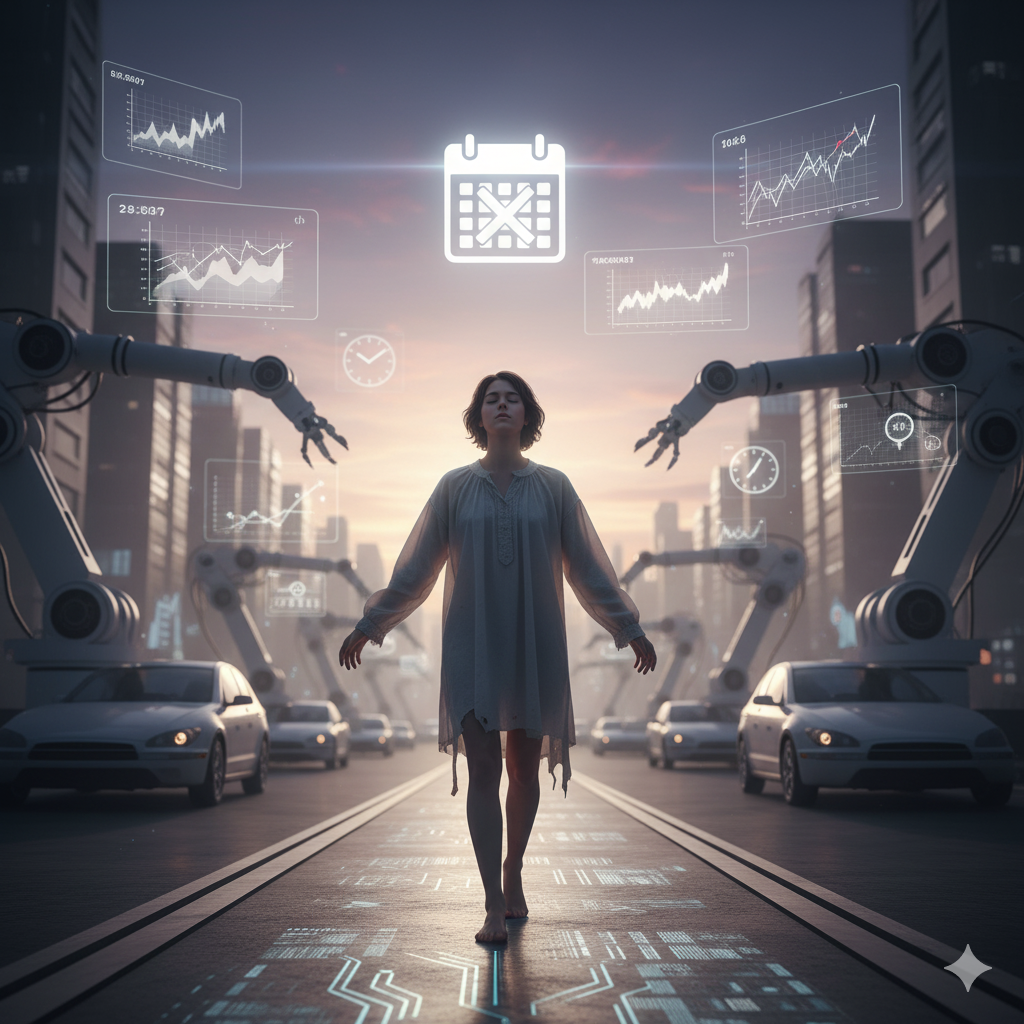
What happens when AI and robotics make traditional jobs obsolete — and how we might redefine purpose.
TL;DR
As AI and robotics advance, we’re heading toward a world where traditional “jobs” may no longer define human worth. The post-work economy won’t just change how we earn — it will transform how we find meaning. The challenge isn’t surviving automation; it’s redefining purpose, dignity, and identity when work is no longer the center of our lives.
The Automation Horizon
For centuries, our societies have been built on the assumption that labor equals value. We work to live — and live, in many ways, to work. But what happens when machines can do nearly everything we can, faster, cheaper, and without complaint?
From self-driving trucks to AI-generated art, the rise of automation is pushing us toward an inflection point — one where human labor becomes economically optional. Some call it the “post-work” economy; others, more ominously, the “end of work.”
And yet, despite this looming reality, we carry on as if the system will somehow absorb the shock. We speak about “upskilling” and “reskilling,” as though the future will still need everyone. But what if it won’t? What if we’re sleepwalking into a world where full employment is a relic, and our biggest social challenge isn’t unemployment — but purposelessness?
The Great Decoupling: Productivity vs. People
In the industrial age, technological progress created new jobs as fast as it destroyed old ones. Automation in one field opened doors in another. But the new wave of AI is different. It’s not just automating manual labor — it’s automating thinking.
This creates a historic decoupling: productivity continues to rise, but employment no longer keeps pace. Corporations can generate massive value with minimal human input. A handful of engineers and algorithms can now do what once required thousands of workers.
Economists call this “technological unemployment.” Philosophers call it post-human efficiency. Either way, it signals a profound economic and cultural shift. When work no longer drives the economy, what will?
The Myth of Infinite Reskilling
Whenever automation threatens jobs, society’s reflexive answer is education. “People will just learn new skills.” But that argument assumes the economy will always create new forms of labor that require uniquely human input.
In a world where AI can code, write, analyze, negotiate, design, and even compose music, what “new skills” remain uniquely human? Creativity, empathy, critical thinking — yes, but even those are being simulated. We can’t all become AI ethicists, brand storytellers, or therapists. The idea that everyone can “reskill” their way out of obsolescence is a comforting illusion — one that postpones a deeper conversation about the role of humans in a fully automated society.
The End of Scarcity — and the Beginning of Existentialism
Here’s the paradox: automation has the potential to solve the very problems that created modern work in the first place. If machines can provide abundance — cheap food, housing, energy, and services — then work as a means of survival could become unnecessary.
That’s utopian on paper. But humans don’t just work to survive; we work to matter. Work gives structure to time, identity to the self, and purpose to community. The post-work economy forces us to confront a question capitalism never had to answer: Who are we when we’re not defined by productivity?
If survival no longer requires work, then meaning must come from somewhere else — creativity, learning, care, connection. But these pursuits require a cultural shift as much as an economic one. It’s not enough to feed and house people; we must also find a way to make them feel needed.
Universal Basic Income: A Lifeline or a Lullaby?
Many futurists propose Universal Basic Income (UBI) as the solution — a guaranteed payment to every citizen, freeing them from dependence on jobs. It’s a powerful idea, but also a double-edged one.
UBI can ensure dignity and stability, but it can also lull society into passive consumption — a world where people survive without participating. Without meaningful engagement, even comfort becomes hollow. The question isn’t just how we’ll pay for UBI, but how we’ll sustain motivation and purpose when money no longer binds us to effort.
History shows that people rarely thrive in idleness. Our challenge is to design systems that nurture contribution without coercion — where people choose to create, teach, build, and explore, not because they must, but because it’s human to do so.
The Rebirth of Purpose
If automation takes work away, perhaps it also frees us to rediscover something older and deeper than employment: craft.
In the pre-industrial world, work was tangible. The carpenter built furniture, the farmer grew food, the weaver made cloth. Their labor was personal and visible. The industrial age turned that into abstraction — jobs became specialized, repetitive, and detached from identity. AI now threatens to complete that detachment, stripping away even the illusion of agency.
But it also opens the door to something revolutionary: the reinvention of purpose. Freed from survival labor, humans could return to creating out of curiosity, compassion, or artistry. The post-work era doesn’t have to be one of decay — it could be an age of renaissance, if we choose to make it one.
Redefining Success in the Post-Work World
If the future no longer revolves around work, we’ll need new metrics for success. GDP, productivity, and profit have long been the scorecards of civilization. But in a post-work society, we may measure progress in terms of well-being, sustainability, creativity, and connection.
Imagine a world where social contribution — mentoring, caretaking, creating — holds more prestige than financial gain. Where education is lifelong, not a phase; where “retirement” doesn’t exist because curiosity never retires.
That shift will require cultural unlearning as much as economic redesign. It asks us to separate identity from occupation — to stop asking children, “What do you want to be?” and start asking, “What do you want to contribute?”
Avoiding the Sleepwalk
The real danger isn’t automation — it’s apathy. As AI and robotics quietly reshape economies, politics, and lives, many of us drift through the transformation in denial. We assume the system will adapt, as it always has. But if we don’t consciously redefine the role of humans in this new order, we risk waking up to a world where purpose has eroded while we weren’t looking.
The post-work future won’t arrive with fanfare. It will creep in — through convenience, through automation, through an endless series of upgrades that make our roles feel smaller and our agency thinner. The question isn’t whether we can stop it. It’s whether we’ll stay awake long enough to shape it.
The Work of Not Working
The irony of the post-work economy is that it demands more work than ever — not labor, but imagination. We’ll need to reinvent social systems, education, and self-concept from the ground up. We’ll need philosophers, designers, and dreamers as much as coders and engineers.
Because when the machines take over the doing, it’s the meaning that remains ours to define.
The end of work, if it comes, doesn’t have to be the end of purpose. It could be the beginning of a society finally free to ask the oldest question in human history — not how to survive, but why.