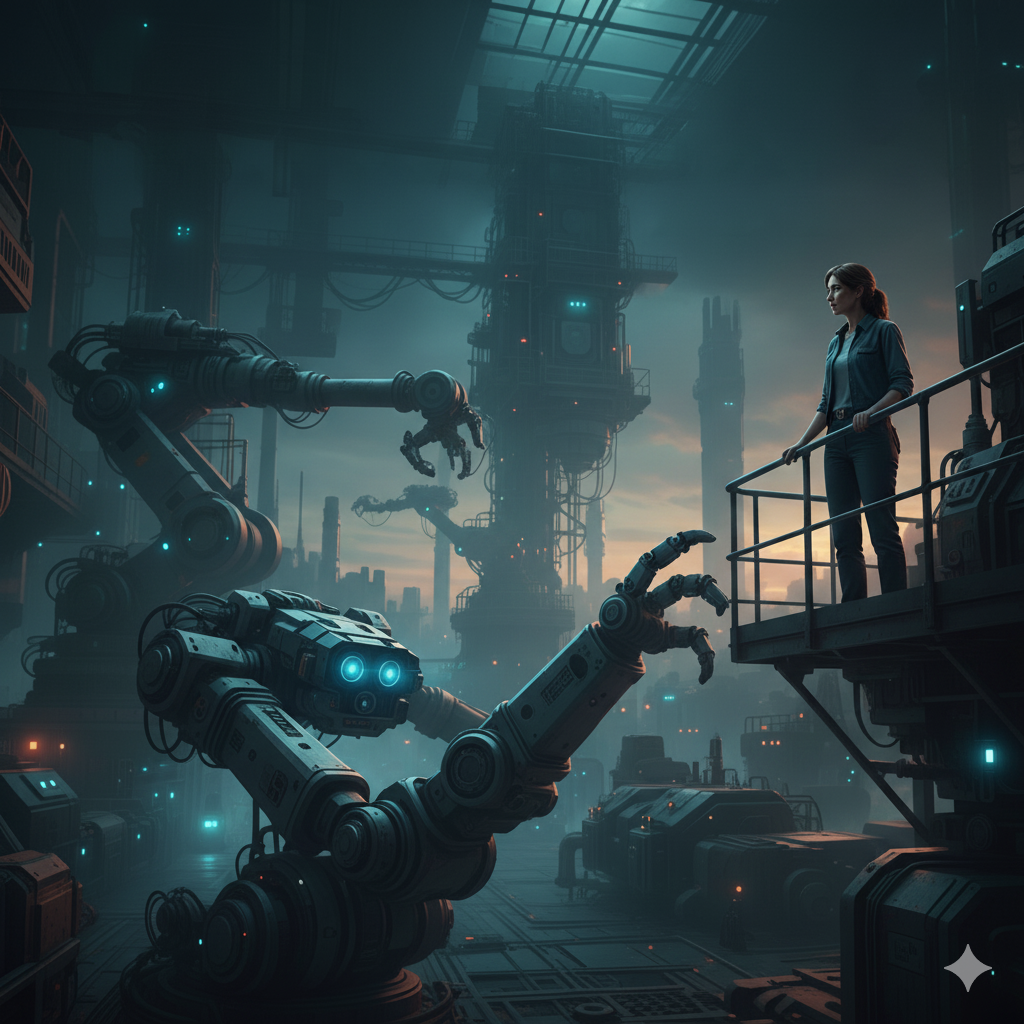
A deep dive into the psychology of automation and the human tendency to distrust our own inventions.
TL;DR
As automation spreads from factory floors to everyday life, our fear of it isn’t just about losing jobs — it’s about losing control. “Automation anxiety” stems from deep-seated psychological and cultural instincts: fear of obsolescence, loss of agency, and distrust of opaque systems. The challenge ahead isn’t defeating automation, but redefining what it means to be usefully human in an increasingly automated world.
The Uneasy Inheritance
From the first mechanical loom to today’s self-driving cars, humans have always built machines that both awe and unsettle us. Each major leap in automation has sparked the same paradox: our inventions promise liberation — from labor, error, and inefficiency — yet they also inspire fear. We fear unemployment, displacement, irrelevance. But beneath these economic anxieties lies something deeper: a psychological discomfort with our own creations.
Automation anxiety is not new. In 1811, the Luddites famously smashed textile machines they believed were taking their livelihoods. Fast forward two centuries, and though the tools have changed — algorithms instead of looms, robots instead of spindles — the unease remains. The difference now is that automation has escaped the factory and entered our everyday lives. Our cars drive themselves, our emails autocomplete, and our devices listen, learn, and anticipate our needs. The machine has moved from tool to colleague — and that’s a profound shift.
The Control Paradox
At the heart of automation anxiety lies what psychologists call the control paradox. Humans build systems to reduce effort and error — yet the less we have to do, the more uneasy we become about our role. When a plane flies itself, we start to distrust the pilot’s relevance; when a chatbot gives medical advice, we question whether doctors are still necessary. The paradox is simple: we crave convenience, but resent dependency.
Automation forces us to confront uncomfortable truths about human limitation. Machines don’t get tired. They don’t forget. They don’t make emotional mistakes. So when they outperform us, it challenges our self-image. We like to believe our value comes from skill, judgment, and intelligence — the very qualities automation threatens to mimic or replace. The result is cognitive dissonance: admiration tinged with insecurity.
The Psychology of Obsolescence
One of the most potent fears automation provokes is the fear of being replaced. Work has long been tied to identity; we don’t just earn a living, we define ourselves by what we do. Automation disrupts that foundation. When a machine performs our job more efficiently, it feels personal — as though the machine isn’t just replacing our labor, but erasing our purpose.
Neuroscience offers a clue: humans are hardwired for agency. We derive satisfaction from influencing outcomes, seeing the results of our actions. When that agency is removed — when the machine takes over — we experience discomfort similar to learned helplessness. It’s not just that we don’t trust the machine; it’s that we stop trusting our own relevance.
This explains why even perfectly safe automation, like autopilot or AI-powered diagnostics, still triggers anxiety. It’s not about malfunction — it’s about meaning. We don’t fear the plane will crash; we fear that we’re no longer needed to keep it airborne.
The Ghost in the Algorithm
Another key source of automation anxiety is opacity. Traditional machines were mechanical — visible, tangible, predictable. You could hear the gears turning, see the cause and effect. AI-driven systems, however, are black boxes. They “learn” and “decide” through processes most users — and even many experts — don’t fully understand.
That opacity breeds distrust. When a machine denies your loan, recommends a sentence in court, or filters what news you see, it’s no longer a neutral tool. It’s an actor in society — one whose motives are hidden behind code and probability. We are being asked to trust decisions we cannot interpret, made by systems we cannot question. It’s not paranoia; it’s a rational response to power without transparency.
Cultural Echoes of Fear
Our fear of automation is not just cognitive — it’s cultural. From Frankenstein to The Terminator, we’ve long mythologized the danger of human creations turning against us. These stories are cautionary tales about hubris: the idea that in playing god, we lose control.
The irony, of course, is that these stories persist because they resonate. Every time we build smarter machines, we relive that archetype — creator versus creation, control versus chaos. Even as we advance technologically, our myths remain medieval: the fear that what we build to serve us will one day surpass us.
This narrative seeps into how we interpret innovation. Autonomous systems don’t just challenge our jobs; they challenge our moral frameworks. When a self-driving car must choose between two lives in an unavoidable crash, who’s responsible? The engineer? The algorithm? The owner? Automation blurs moral accountability, and that lack of clarity amplifies unease.
The Reality Check
Despite the drama, the reality of automation is more nuanced than dystopian headlines suggest. Historically, technology has both destroyed and created jobs. The industrial revolution eliminated weavers but created engineers. The digital age displaced clerks but created coders.
The same pattern is emerging now: while automation replaces routine labor, it also generates new roles that demand creativity, strategy, and empathy — distinctly human strengths. Yet this transition is not frictionless. The pace of change outstrips our ability to adapt socially, economically, and psychologically. The fear is not just about losing work; it’s about losing the meaning of work before we’ve built a new one.
Redefining Human Value
If automation anxiety reveals anything, it’s that our definition of human worth needs updating. For too long, we’ve equated productivity with value. But in a world where machines can outperform us on speed, precision, and endurance, our worth must shift toward qualities automation cannot replicate: creativity, empathy, ethics, and imagination.
Instead of competing with machines, we can collaborate with them. AI can handle the repetition; humans can provide the reflection. Automation can manage the process; humans can give it purpose. The future of work — and of humanity — lies not in resistance but reorientation.
We are not the Luddites of the digital age; we are the curators of a new balance between human and machine intelligence. That balance requires humility, awareness, and perhaps most importantly, trust — not blind trust in automation, but confidence in our ability to shape it responsibly.
Fear as a Feature
In the end, automation anxiety isn’t a flaw in human psychology — it’s a feature. It’s the instinct that keeps us cautious, ethical, and reflective about the technologies we unleash. Fear reminds us that progress without oversight is dangerous, and that the machines we build must serve humanity, not the other way around.
Automation doesn’t have to make us obsolete. But it does challenge us to reimagine what it means to be human when the tools we’ve created can think, act, and decide faster than we can. The question isn’t why we fear the machines we built — it’s whether we can evolve fast enough to deserve the trust we give them.