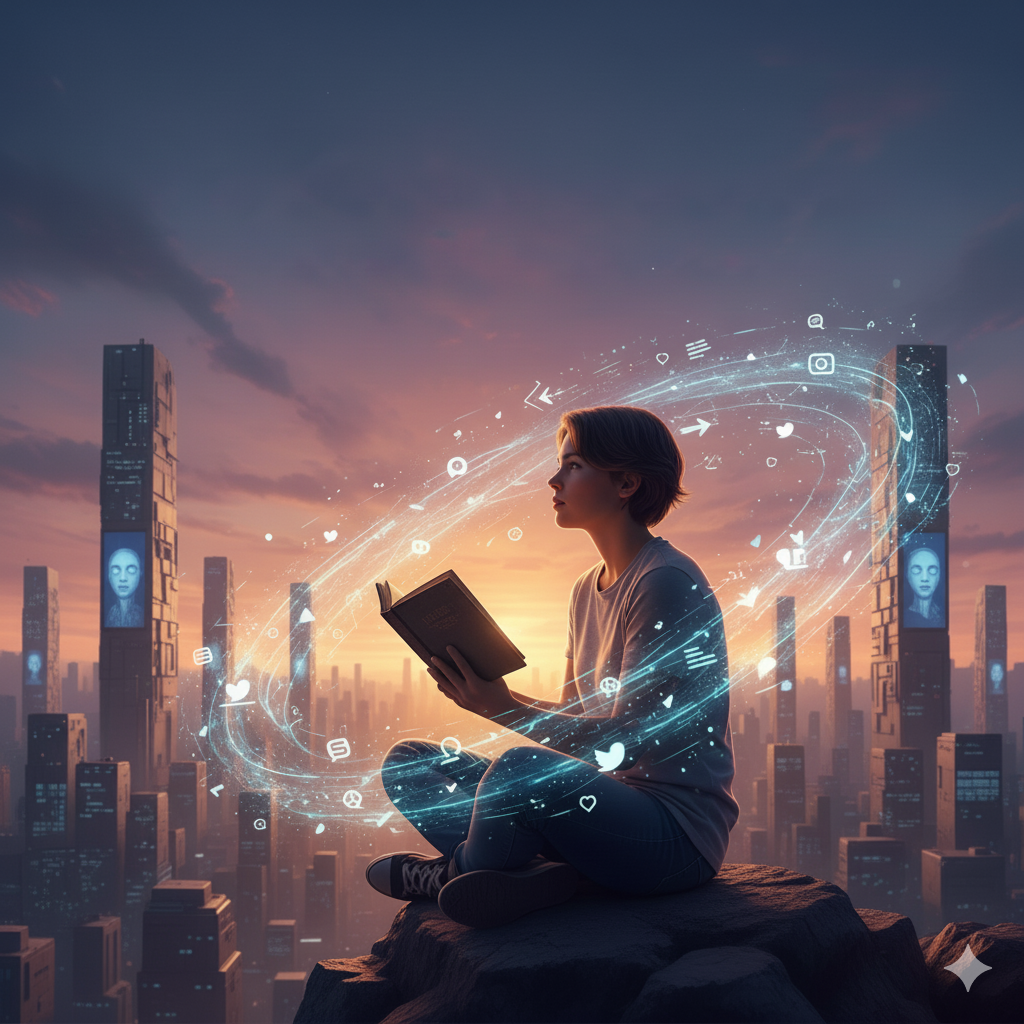
Exploring how generative AI is shaping human creativity, critical thinking, and decision-making.
We are living in the most intellectually paradoxical moment in history. On one hand, we have more access to information, creativity, and computational power than any generation before us. On the other, we may be the first to voluntarily hand over the process of thinking itself. As generative AI begins to write our essays, design our graphics, compose our music, and even generate our ideas, an uncomfortable question emerges: Are we still thinking for ourselves—or are we simply curating what the machines produce?
The Convenience Trap
The appeal of AI-generated content is undeniable. Need a blog post, marketing plan, or product concept? Type a prompt, press enter, and voilà — the machine delivers. What once took hours or days of brainstorming, research, and iteration now happens in seconds. The convenience is seductive. But convenience has always been the first step toward dependency.
We once had to memorize phone numbers; now, we simply scroll. We once navigated by instinct or map; now we trust GPS even when it sends us the wrong way. Generative AI takes this cognitive outsourcing further — it doesn’t just store information, it produces it. The risk isn’t that AI will outthink us. It’s that we’ll stop bothering to think at all.
From Tool to Thought Partner
In the early days of personal computing, technology amplified human ability. Word processors, spreadsheets, and search engines made us faster and more efficient but didn’t fundamentally alter how we reasoned or created. Generative AI is different. It doesn’t just assist in creation; it participates. When we ask an AI to “write a headline” or “design a logo,” it’s not a passive process — the machine contributes ideas, patterns, and perspectives that shape the final output.
This partnership can be extraordinary. A novelist can overcome writer’s block by prompting an AI for dialogue suggestions. A scientist can simulate hypotheses before running physical experiments. A designer can generate hundreds of visual concepts in minutes. But this creative abundance comes with a subtle psychological shift: we begin to rely on the machine’s imagination, and our own may quietly dim.
The Erosion of Cognitive Struggle
Human creativity has always been born of friction — the blank page, the unsolved problem, the long walk that ends in an idea. The creative struggle was never just a byproduct; it was the process itself. It forced us to refine, to persist, to understand. AI removes that friction. And in doing so, it risks removing the growth that comes from it.
When an algorithm completes our thoughts, it also shields us from the discomfort of uncertainty — the essential ingredient of deep thinking. It’s in uncertainty that we question assumptions, explore new angles, and develop insight. If machines can supply answers faster than we can ask questions, what becomes of curiosity?
The Mirage of Objectivity
One of the great myths of AI is its supposed objectivity. In reality, AI mirrors the data and biases of the humans who build and train it. The machine may seem neutral, but its suggestions and outputs are shaped by patterns of human behavior — often flawed ones. When we rely on AI for decision-making, whether in hiring, finance, or creative work, we risk mistaking algorithmic consensus for truth.
The more decisions we offload, the more we normalize the idea that machines know better. And that belief slowly shifts our cognitive baseline: instead of thinking critically about what’s produced, we evaluate based on efficiency, not accuracy; novelty, not nuance.
The New Literacy
Yet all is not lost. Just as the printing press once forced society to develop reading literacy, the rise of AI demands a new kind of literacy — prompt literacy. Knowing how to question, direct, and interpret machine-generated output becomes as important as knowing how to read and write.
The thinkers and creators of tomorrow won’t be those who passively accept AI’s results, but those who understand how to collaborate with it meaningfully. They will treat AI not as an oracle, but as a mirror — a tool for reflection and augmentation, not replacement.
In this light, the future of thinking isn’t about rejecting AI, but mastering it. We need to cultivate awareness of when we’re using AI to extend our imagination and when we’re letting it narrow our perspective.
Creativity in the Age of Assistance
Interestingly, the best AI-generated work often comes from those who already possess deep creative or technical expertise. A skilled designer will get more from a text-to-image model than a novice. A talented writer will craft better prompts than someone who’s never struggled with structure or tone. In other words, the more human knowledge you bring to the table, the more the machine amplifies it.
This is the paradox of the new creative era: AI doesn’t replace talent — it multiplies it. But for those who never develop the underlying skills, it can quickly become a crutch. It’s like giving a calculator to someone who never learned arithmetic. You may get answers faster, but you’ll never understand how you got there.
Thinking Beyond Efficiency
Efficiency has long been the gospel of progress. But what if the future doesn’t need more speed — it needs more depth? As machines accelerate output, human value will increasingly lie in interpretation, ethics, and emotional intelligence. The question isn’t whether AI can create — it clearly can. The question is whether we can still find meaning in what’s created.
Our task, then, is to defend slowness. To preserve the spaces where thinking happens not for productivity’s sake, but for the sheer act of wondering. AI may predict the next word in a sentence, but it cannot predict the why behind it — that restless spark that drives human imagination forward.
The Human Imperative
So, are we the last generation to think for ourselves? The answer depends on what we choose next. We can either drift into passive consumption — a society of editors, not authors — or we can use AI as a catalyst to deepen our understanding of what makes thought human.
In the end, thinking for ourselves isn’t about rejecting technology. It’s about preserving the capacity for curiosity, contradiction, and surprise. Machines can simulate logic, but they can’t feel wonder. And as long as we keep wondering, questioning, and creating with intent — we’ll never truly be asleep at the wheel.